Most days, I architect systems. I think about latency, schemas, the quiet logic of how data moves from one place to another without anyone noticing the seams. It’s a strange kind of work. You spend your hours building things that, if you build them well, no one will ever see.
At some point a few years ago, I noticed I was thinking about novels the same way.
A good mystery, the kind I grew up reading, is a closed system. It has rules. It has hidden state. It has a moment, near the end, when everything that seemed random reveals itself as the deterministic output of choices made long before the story began. Every clue is a variable. Every red herring is a misdirection in the control flow. The reader, if the writer has done it right, finishes the book and realises that the answer was always there, in plain sight, encoded in the structure.
That’s the kind of puzzle I wanted to write. So I wrote one.
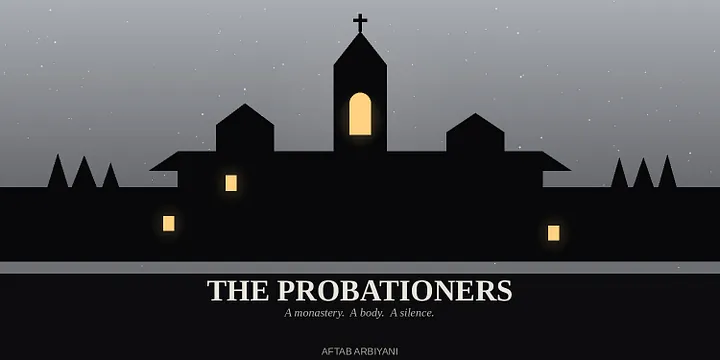
It is called The Probationers. It went live on Amazon last week.
The premise
At a Benedictine monastery in the Umbrian hills, six postulants are midway through the year-long novitiate that will decide the rest of their lives. On the morning of the mid-winter feast, the Novice Master is found at the base of the bell tower. The snow is still falling. The abbey is locked in. The community is already calling it an accident.
It is not an accident.
A canon lawyer is sent from Rome with one instruction: find out what happened before the civil authorities arrive. She has seven days. She has six postulants, each one hiding something. She has the men who built this community and have lived inside it for decades. And she has the gradual, unsettling understanding that the abbey’s silence is not the silence of innocence. It is the silence of people who have learned, over years and decades, exactly how much a secret costs.
I will not tell you who did it. The book takes care of that.
Why a monastery
People keep asking me why a coder from India set a novel inside a Benedictine enclosure in central Italy. The honest answer is that I was not really writing about monks. I was writing about closed systems and what they do to the people inside them.
A monastery is the purest closed system I could imagine. There are rules that everyone has agreed to. There is a daily structure so regular that any deviation stands out instantly. There is a finite cast of characters, all of whom know each other intimately, all of whom have chosen to be there. There is a long institutional memory. And there is the central, defining fact that every person inside the walls has, at some point, made a vow.
That last part is what hooked me. A vow is a kind of contract you sign with yourself. It says: from this point forward, I will be a particular kind of person. And the most interesting question I could think of was, what happens when the cost of remaining that person becomes higher than you ever imagined it would be?
Become a Medium member
That question turned out to be the spine of the book.
What I learned writing it
A few things I did not expect.
The first is that fiction is much harder than software, and in the same way. In code, a bug is something you can isolate, reproduce, and fix. In a novel, a bug is a scene that does not quite land, a character whose motive feels theoretical, a clue that the reader will spot too early. You cannot reproduce it in a debugger. You can only feel that something is off, and then sit with the discomfort until you understand what it is.
The second is that the parts of the writing process I dreaded turned out to be the parts I loved. I dreaded the outlining, because I thought it would kill the joy of discovery. It did the opposite. Knowing the architecture freed me to be playful with the prose. A mystery without an outline is a house without a foundation. You can put the walls up, but the cracks will show.
The third is that I wrote the killer last, in a sense. I knew who it was from the start, but I did not understand him until very late. The killer in The Probationers is not a monster. He is the most loved person in the community, and he kills for reasons that, when you understand them, are not evil. They are sad. They are the saddest reasons I could give him. And I think that is what I am most proud of in the book, that the ending does not feel like a verdict. It feels like a kind of disturbed compassion.
I wanted readers to finish the book and feel that a person can give their whole life to something and be, simultaneously, the thing most endangered by that gift.
For readers of
If you read Tana French and like the way she takes a mystery and turns it slowly into a portrait of a place, this book is for you. If you loved The Secret History and the long, watchful quality of being inside a small, closed group with too many secrets, this book is for you. If you go back to Agatha Christie because no one else builds a puzzle quite that cleanly, I have tried, very carefully, to honour that tradition. And if The Name of the Rose lives on your shelf, you will recognise the world I am writing about, though the book is shorter, the tone closer to literary mystery than to historical epic.
Roughly 102,000 words. Seven days. Six suspects. One body. A community that has been keeping its secrets for sixty years.
What’s next
I am already at work on the next one. Different setting, different investigator, the same obsession. I think writers spend their whole careers writing the same book a different number of ways, and I am only just starting to figure out what mine is.
If you read The Probationers and have thoughts, I would genuinely love to hear them. Reviews on Amazon help a debut book more than I can describe. Even a sentence. Especially an honest one.
The book is on Amazon now, in Kindle and on Kindle Unlimited. The paperback is on its way.
Read The Probationers on Amazon →
Thank you for reading this far. The fact that anyone reads anything I write still feels improbable to me, and I do not take it for granted.
Aftab Arbiyani
Ahmedabad, India