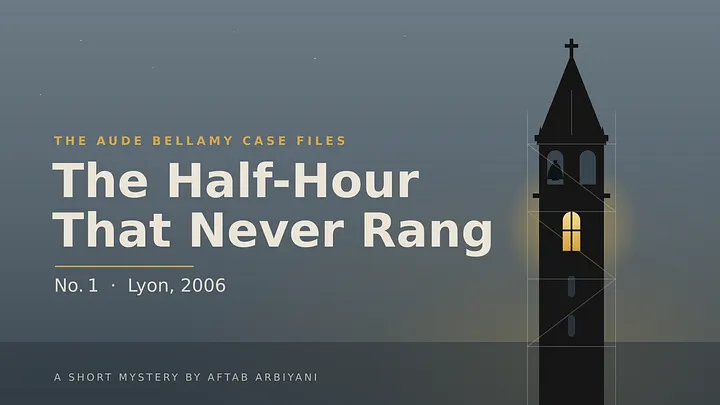
Judge Hervé Lacombe died at his own desk, in his own study, with a glass of cognac at his elbow and the lamp still warm. He was sixty-eight, heavy, and had survived two heart attacks already. When Aude Bellamy arrived, the police doctor had all but written the third one into the file.
"He'd been warned," the doctor said, not unkindly. "Salt, brandy, late nights. A man like that, it's only ever a matter of which evening."
Aude said nothing. She was thirty-three that autumn, and still young enough as a juge d'instruction to believe that saying nothing was a kind of method. She walked the study instead. The desk faced the window; the window faced the spire of Saint-Nizier two streets away, pale under its cage of restoration scaffolding. A decanter, three glasses, two of them used. A fountain pen, capped. A single sheet of paper, blank, squared to the blotter as though Lacombe had meant to begin something and had been interrupted by his own heart.
Three people had been in the house.
Sabine Lacombe, the second wife, thirty years younger than her husband, found Aude in the hall and wept with the fluency of a woman who had rehearsed grief privately before it was required of her. She had been upstairs, she said, since nine. She had heard nothing.
Théo Marchand, the judge's clerk, was twenty-six and grey-faced. He had found the body at ten o'clock when he came to collect the week's dictation. He had touched nothing, he said, except the wrist, to be sure. His hand still shook when he said it.
And then there was the third.
President Honoré Salenc was the most senior magistrate in the city, a man whose name Aude had seen at the foot of judgments since her law-school years. He sat very upright in the drawing room with his hat on his knee, and when he spoke of Lacombe his voice did the work that grief had not yet managed to do for him.
"Forty years," he said. "We were called to the bar the same season. I dined here tonight as I have dined here a hundred times." He looked at Aude with the frank, tired authority of a man accustomed to being believed. "We took cognac in his study. He was in good spirits — better than I'd seen him in months. I left at half past nine. I remember it precisely, because Saint-Nizier struck the half-hour as I stepped into the street, and I thought, there, that's the bell, I'll be home before ten." He spread his hands. "He was alive when I left him. Laughing. I would stake my office on it."
And Aude believed him.
She would remember that, later, with a particular discomfort. She believed him not because of anything he had said but because of what he was — a president of chambers, a man who had taken the same oath she had, whose whole life was the institution she served. She had been raised, professionally, to trust such men. The trust felt less like a decision than like gravity.
So she turned, as the police doctor had, toward the easier shapes. The young wife and the young clerk. She asked Sabine about the will, and watched her flinch. She asked Théo why his hand shook, and watched him not quite meet her eye. She built, in the privacy of her head, two serviceable little stories, and for the better part of an hour she preferred them to the truth.
It was the blank sheet of paper that stopped her.
A man does not square a blank page to his blotter and cap his pen unless he has decided what to write and means to write it. Lacombe had been about to set something down. Something he had not wanted to dictate to a clerk in the morning. Aude asked Théo what the judge had been working on.
"A complaint," Théo said, and then, when she waited: "Against a colleague. He wouldn't say who. He'd been to the archives three times this month. Old files. Twelve, fifteen years old." He swallowed. "He told me last week — he said, Théo, the worst rot is always at the top, and the top always thinks itself the floor."
Old files. Fifteen years old. A complaint against a colleague, written by hand, by a dying man who would not trust it to anyone.
Aude went back into the study and stood at the window and looked at Saint-Nizier in its scaffolding, and the discomfort she had been carrying all evening finally found its shape.
She had passed under that scaffolding on her way in. There had been a notice wired to the hoarding, the kind the diocese posts to apologize for an inconvenience. She had read it the way one reads such things, without reading them, and only now did the words assemble themselves in her memory.
The bells of Saint-Nizier are silenced for the duration of restoration works. We thank the faithful for their patience.
Silenced. For weeks. The whole quarter had been living without its hours.
Saint-Nizier had not struck the half-past-nine that President Salenc claimed to have heard as he stepped into the street.
He could not have heard a bell that did not ring. Which meant he had not invented the detail to remember the time — he had invented it to furnish a time, to nail himself to the doorstep at half past nine with a living man behind him. A man supplies a false witness like that for one reason only: because the true hour is the dangerous one. Because Lacombe had not been alive at half past nine. Because he had already been at his desk, his complaint unwritten, his pen capped, his heart stopped not by salt and brandy but by the colleague whose name was waiting in those fifteen-year-old files — the colleague who had sat in the study taking cognac and watching an old friend die, and who had then washed his own glass and left a second one out, and walked into the street rehearsing a bell.
Aude did not arrest President Salenc that night. She was thirty-three, and he was who he was, and she wanted the autopsy and the archive before she put her hand on the most senior magistrate in Lyon. But she had stopped believing him, and the stopping was the thing she carried away.
The toxicology took nine days. A cardiac glycoside, the kind that finishes a failing heart and looks, to a tired doctor at eleven at night, exactly like the failure everyone is already expecting. The archive took longer. But the file Lacombe had pulled three times that month concerned a judgment Salenc had handed down in 1991, in a fraud case, in favour of a company that had, six weeks later, quietly settled a great deal of money on a numbered account that was not quite as anonymous as it had been meant to be.
The worst rot is always at the top. And the top always thinks itself the floor.
At the committal, Salenc's advocate asked Aude how she had first come to doubt his client, given the — he chose the word with care — unimpeachable standing of a president of chambers.
"I didn't doubt him," Aude said. "That was my error, and I will own it. I believed him completely, because of his office. I nearly let him walk out of that house on the strength of forty years of judgments with his name at the foot." She paused. "He was undone by a bell that didn't ring. Not by my suspicion. I had none. A man that far above suspicion only has to be careful about the small true things, and he forgot one."
She did not say the rest of it, which was for herself. That the office she had trusted was the same office he had used to kill, and that the trust she gave to vows and titles and the men who held them was not a virtue but a blind spot, a door she left unlocked. She told herself, walking out of the courthouse into the cold, that she would remember it. That she would never again give an institution the benefit of the doubt she would not give a stranger.
She believed that, too.
It would be twenty years, and a monastery, and a man even further above suspicion than Honoré Salenc, before she learned how little such promises are worth — and how much it costs to learn it twice.
Sister Aude Bellamy made that second promise good, and broke it, in a snowed-in Benedictine abbey where a beloved man was found at the foot of the bell tower. If you'd like to follow her into the case that nearly ended her — and meet the killer who hid for sixty-four years in plain sight — The Probationers is out now.
👉 Read* The Probationers *on Amazon
New case files in this series post regularly. Follow to read the next one.